
Pakistan remains firmly committed to advancing peace,economic connectivity, and multilateral cooperation in the region under the framework of SCO

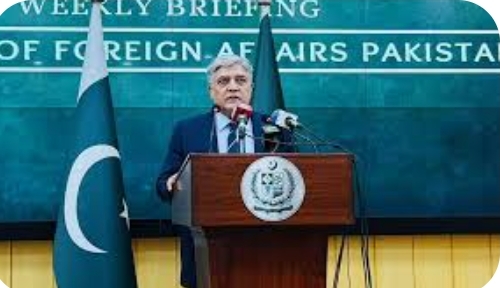
Islamabad : Foreign Office Spokesperson says Pakistan remains firmly committed to advancing peace, economic connectivity, and multilateral cooperation in the region under the framework of the Shanghai Cooperation Organization (SCO). Prime Minister Muhammad Shehbaz Sharif, during his recent visit to China from August 31 to September 1, attended the SCO Council of Heads of State (CHS) and the SCO CHS Plus meetings in Tianjin.
At the invitation of Chinese President Xi Jinping, the Prime Minister held high-level meetings with SCO member states and key regional leaders. Prime Minister Shehbaz Sharif emphasized the need for a comprehensive and result-oriented dialogue to resolve longstanding disputes in South Asia, strongly condemned all forms of terrorism, including state-sponsored terrorism, and presented undeniable evidence of foreign involvement in the Jaffer Express hostage crisis as well as in recent terrorist incidents in Balochistan and Khyber Pakhtunkhwa.
He also strongly condemned Israeli military actions in Gaza, terming them “inhuman,” and called for an immediate and unconditional ceasefire. He condemned the recent attack on SCO member state Iran as well.
Sharing details of the Prime Minister’s visit to China at the weekly press briefing on Friday, Foreign Office Spokesperson Shafqat Ali Khan said that the Prime Minister, while addressing the SCO forum, underscored the importance of meaningful engagement with Afghanistan, stressing that instability in Afghanistan undermines the development of the entire SCO region.
The Prime Minister also highlighted the significance of regional connectivity and economic integration, presenting Pakistan’s strategic geographical location as a potential trade and transit hub for the SCO. He termed the China-Pakistan Economic Corridor (CPEC) as the cornerstone of regional integration under President Xi Jinping’s Belt and Road Initiative (BRI).
The spokesperson said that on the sidelines of the summit, the Prime Minister held bilateral meetings with the Presidents of China, Russia, Türkiye, Iran, Azerbaijan, and Tajikistan, focusing on enhancing political, economic, trade, energy, and defense cooperation. Notably, the Prime Minister congratulated Azerbaijani President Ilham Aliyev on the signing of the historic peace agreement with Armenia, describing it as an important step towards peace in the South Caucasus.
During his meeting with President Xi Jinping, the Prime Minister reaffirmed Pakistan’s unwavering support for China’s territorial integrity and commended China’s achievements in economic development. In discussions with Chinese Premier Li Qiang, the focus remained on expanding cooperation in emerging sectors and supporting President Xi Jinping’s multilateral initiatives, including the Global Security, Development, and Prosperity initiatives.
The Prime Minister also addressed the Pakistan-China Business-to-Business (B2B) Investment Conference, which was attended by more than 800 companies, where he identified agriculture, mining, IT, textiles, and industrial development as key areas for future cooperation.
Spokesperson Shafqat Ali Khan further stated that Prime Minister Shehbaz Sharif also attended the ceremony marking the 80th anniversary of China’s victory, where he joined other world leaders in commemorating the triumph in World War II.
Highlighting other diplomatic achievements, the spokesperson said that Pakistan and Armenia formally established diplomatic relations with the signing of a joint communiqué during a meeting between Deputy Prime Minister and Foreign Minister Senator Mohammad Ishaq Dar and Armenian Foreign Minister Ararat Mirzoyan. Both sides reaffirmed their commitment to the UN Charter and discussed cooperation in economy, education, tourism, and culture.
He also shared further details of high-level exchanges. Senator Ishaq Dar held bilateral meetings with the Foreign Ministers of Germany and the European Union, who expressed solidarity over the recent devastation caused by floods in Pakistan. Discussions focused on climate action, resilience, reconstruction, and sustainable recovery, with the EU reaffirming its support for Pakistan’s relief efforts. The Foreign Minister also conveyed condolences over the recent earthquake in Afghanistan and reiterated Pakistan’s offer of assistance.
Underscoring progress in science, Spokesperson Shafqat Ali Khan noted that a high-level delegation from the European Council for Nuclear Research (CERN) visited Pakistan from August 24–28 to review Pakistan’s role as an Associate Member. The delegation held meetings with officials of the Pakistan Atomic Energy Commission (PAEC) and visited various scientific institutions.
Responding to the recent situation in Gaza, the spokesperson condemned the Israeli airstrike on Nasser Hospital in Khan Younis, which killed 21 people, including four journalists and a rescue worker. He termed the attack a grave violation of international humanitarian and human rights law and called for immediate accountability.
He reaffirmed Pakistan’s full support for Syria’s sovereignty and territorial integrity, urging the international community to take steps to prevent further Israeli aggression in the region.

Comments are closed.