

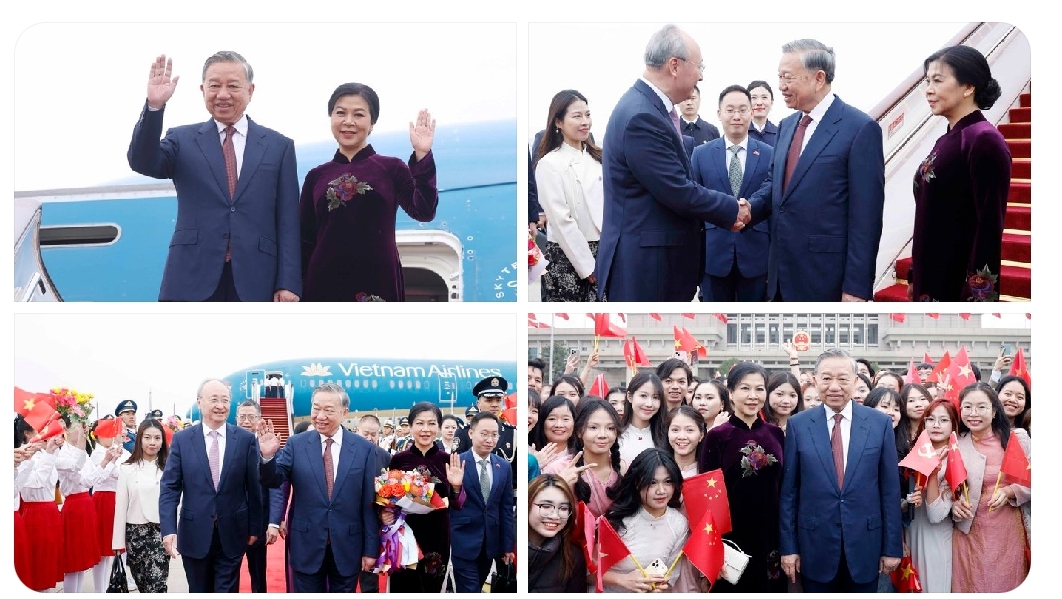
Beijing: General Secretary of the Communist Party of Vietnam and State President Tô Lâm arrived in Beijing, embarking on a three-day official visit to China at the invitation of his Chinese counterpart, President Xi Jinping.
The visit marks an important development in bilateral relations between Vietnam and China, underscoring continued efforts by both nations to strengthen political trust, expand economic cooperation, and enhance strategic coordination.
Upon arrival in the Chinese capital, President Tô Lâm was received by senior Chinese officials in a gesture reflecting the significance Beijing attaches to the visit.
During his stay, Tô Lâm is scheduled to hold comprehensive talks with President Xi Jinping, as well as meetings with other top Chinese leaders.
The discussions are expected to cover a wide range of issues, including trade, investment, infrastructure development, and collaboration under regional initiatives.
Both sides are also likely to deliberate on regional and global developments, with particular focus on maintaining stability and fostering cooperation in the Asia-Pacific region.
Economic ties are anticipated to feature prominently on the agenda, as China remains one of Vietnam’s largest trading partners.
Leaders from both countries are expected to explore opportunities to further boost bilateral trade, promote supply chain connectivity, and expand cooperation in emerging sectors such as technology, green energy, and digital economy.
At the same time, analysts note that the visit provides an opportunity for both sides to manage sensitive issues, including longstanding maritime disputes in the South China Sea, through dialogue and diplomatic engagement.
Several agreements and memoranda of understanding are expected to be signed during the visit, aimed at deepening cooperation across multiple sectors. Cultural and people-to-people exchanges may also be highlighted to strengthen mutual understanding between the two nations.
The three-day visit reflects a shared commitment by Hanoi and Beijing to maintain stable, constructive, and forward-looking relations amid evolving regional and international dynamics.
