

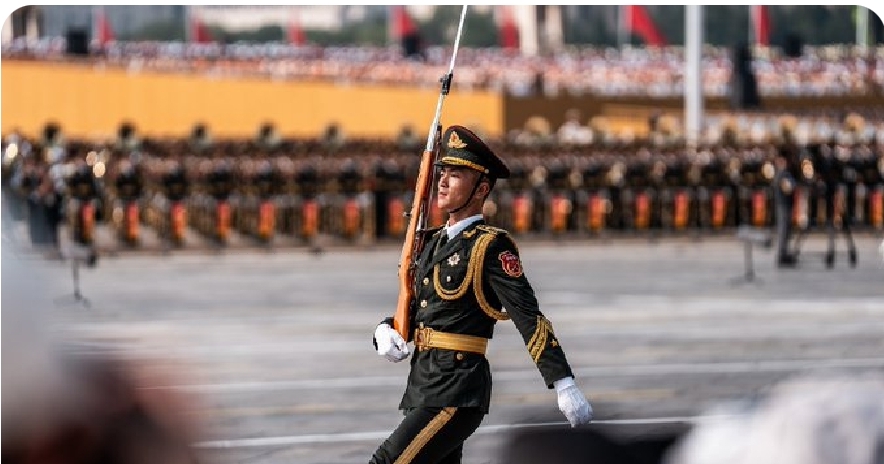
Beijing: China commemorated its Victory Day on September 3, marking eight decades since the conclusion of World War II. The event gained significant recognition from military experts, media analysts, and global leaders for its historical importance and diplomatic value.
The highlight of the commemorations was a grand military parade featuring thousands of People’s Liberation Army troops and advanced weaponry, including hypersonic missiles, stealth aircraft, underwater drones, and intercontinental ballistic missiles. The presence of world leaders such as Russia’s President Vladimir Putin and North Korea’s Kim Jong Un underscored strategic partnerships and reinforced China’s image as a unifying force among developing nations.
Slovak Prime Minister Robert Fico, who attended the event, stressed the importance of global participation, calling it a “great mistake” for EU leaders to ignore the occasion. The parade also attracted attention from Japan, where reactions reflected both awe and growing concern over China’s expanding military capabilities.
Observers in the United States and international media say China’s recent military parade was designed to highlight Beijing’s growing strength, cohesion, and ambitions as a global power.
Richard Bush of the Brookings Institution told Taipei Times that China appears intent on conveying it “is getting stronger and stronger.” Bonnie Glaser of the German Marshall Fund added that the parade also promoted China’s Global Governance Initiative and reinforced its wartime narrative.
Global media emphasized the display of China’s domestically developed weaponry. Foreign Policy noted that China is no longer merely catching up to other military powers but is now innovating and leading in certain domains. This shift, the publication said, is altering regional military balances that had long favored the U.S. and its partners.
The Indian Express reported that the parade underscored the strength of the Chinese nation. Meanwhile, The Straits Times interpreted it as a signal that Beijing views its wartime history as central to its identity as a major international power committed to multilateralism and stability.
Military experts have pointed to significant progress in China’s defense capabilities following its latest military parade, which unveiled a series of advanced weapon systems.
Raymond Kuo, director at Rand Corporation, told The Guardian that the display of a submarine-based intercontinental ballistic missile marked a major step in China’s efforts to develop a complete nuclear “triad,” with strike capabilities spread across land, air, and sea to ensure resilience and balance.
Russian analyst Alexey Anpilogov highlighted that for the first time, China presented its strategic nuclear forces in a comprehensive manner, also drawing attention to the advanced anti-drone systems showcased during the event.
Experts have underscored the growing threat from drones, stressing the need for countermeasures that are inexpensive, mass-produced, and effective. China, they noted, demonstrated the strength of its defense industry by producing some of the world’s most advanced weapon systems.
“From massive underwater torpedoes to state-of-the-art laser weapons designed to shoot down drones, China’s latest military parade will now be closely studied by Pentagon experts and defense officials worldwide,” wrote Frank Gardner, security correspondent at the BBC.

Comments are closed.